The Oranje Nassau Pavilion is one of the main indoor flower pavilions at Keukenhof and a great place to discover a completely different side of the Dutch flower industry. While the outdoor gardens are famous for millions of spring-flowering bulbs, the Oranje Nassau Pavilion focuses on spectacular indoor flower shows and changing floral displays.
Throughout the Keukenhof season, the pavilion hosts different flower exhibitions. This means that what you see during a visit in March may be quite different from what visitors experience several weeks later.
For flower lovers, photographers and visitors interested in horticulture, the Oranje Nassau Pavilion is well worth adding to your route through Keukenhof.
What is the Oranje Nassau Pavilion?
Keukenhof is much more than an outdoor tulip garden. Several large pavilions are located throughout the park, each with its own character and exhibitions.
The Oranje Nassau Pavilion is particularly known for its changing flower shows. Growers and specialists present flowers in elaborate arrangements, allowing visitors to see individual varieties from close range.
Rather than simply displaying rows of flowers, many presentations are designed as complete floral scenes. Colours, shapes, textures and different varieties are combined to demonstrate what professional growers and floral designers can create.
Because exhibitions change during the season, the pavilion also gives returning visitors a reason to come back.
Changing flower shows throughout the season
One of the most interesting aspects of the Oranje Nassau Pavilion is that its displays are not necessarily the same throughout the entire Keukenhof season.
Different flowers have their own flowering periods, and the exhibitions are planned around these seasonal moments.
Depending on the date of your visit, displays can feature flowers such as:
- Tulips
- Daffodils
- Hyacinths
- Roses
- Chrysanthemums
- Calla lilies
- Gerberas
- Freesias
- Alstroemerias
- Other cut flowers and seasonal varieties
The exact programme can vary from year to year.
For visitors, this makes the pavilion particularly interesting because it reflects the changing flower season rather than presenting one permanent exhibition.
More than just tulips
Many international visitors associate Keukenhof almost entirely with tulips. Tulips are certainly the stars of the park, but the Oranje Nassau Pavilion demonstrates just how diverse the Dutch horticultural industry really is.
The Netherlands is one of the world's most important centres for the cultivation, trade and development of flowers and plants.
Inside the pavilion you can discover varieties that you might normally only see individually at a florist. Here, they are brought together in large displays where subtle differences in colour, size and shape become much easier to see.
It is a good reminder that a visit to Keukenhof is not only about tulips.
A paradise for flower photography
The Oranje Nassau Pavilion can be particularly rewarding for photographers.
Outside, photographing flowers can depend heavily on sunshine, clouds, wind and crowds. Inside the pavilion, conditions are more controlled and many flowers can be viewed from close range.
Look beyond the large displays and pay attention to individual details.
The centre of a flower, the transition between two colours on a petal or the structure of a complete arrangement can sometimes produce a more interesting photograph than a wide shot of an entire display.
Photography tip
Take both overview photographs and close-ups.
Start with a wider photograph to capture the complete flower show. Then move closer and photograph individual varieties, petals and colour combinations.
And remember: the most colourful display is not always the best photograph. Some of the more subtle arrangements can be surprisingly beautiful.
A useful indoor stop during your Keukenhof visit
The pavilion is also useful from a practical point of view.
Keukenhof is largely an outdoor attraction, and Dutch spring weather can change quickly. Sunshine, wind and rain can sometimes occur on the same day.
An indoor pavilion therefore makes an excellent stop when the weather becomes less pleasant.
Rather than seeing rain as a reason to interrupt your visit, use it as an opportunity to explore one of Keukenhof's indoor exhibitions.
On colder days, it can also be pleasant to alternate between the outdoor gardens and the indoor pavilions.
How much time should you allow?
For most visitors, approximately 20 to 40 minutes is a reasonable amount of time for the Oranje Nassau Pavilion.
Flower enthusiasts and photographers may easily spend longer.
How much time you need also depends on the exhibition taking place during your visit and how busy the pavilion is.
We recommend not rushing through it simply because it is an indoor attraction. Take some time to look at the names and differences between the flowers and varieties on display.
Is the Oranje Nassau Pavilion included with a Keukenhof ticket?
The flower pavilions inside Keukenhof are normally part of your visit once you have entered the park. You do not generally need a separate admission ticket simply to enter the Oranje Nassau Pavilion.
This makes it easy to combine the pavilion with the rest of your day at Keukenhof.
Accessibility
Keukenhof is designed to welcome a wide range of visitors, and the Oranje Nassau Pavilion can be incorporated into a route through the park by visitors with reduced mobility.
Visitors using wheelchairs, mobility aids or pushchairs should allow a little extra time during busy periods, as indoor exhibitions can become crowded.
If accessibility is particularly important for your visit, check the latest Keukenhof visitor information before arrival, as facilities and arrangements can change.
Toilets and visitor facilities
Various visitor facilities, including toilets and food and drink locations, are available throughout Keukenhof.
We recommend checking the Keukenhof map when you arrive. This makes it much easier to combine the pavilion with nearby gardens, restaurants, toilets and other attractions without repeatedly walking across the park.
A map is especially useful if you want to see several indoor pavilions during the same visit.
When is the best time to visit the pavilion?
There is no single best time because the exhibitions change throughout the season.
If your main concern is avoiding crowds, visiting earlier in the day can be advantageous. The busiest periods can occur when large numbers of visitors move indoors at the same time, particularly during poor weather.
However, don't skip the pavilion simply because it looks busy.
Visitor flow changes constantly, and waiting a short while or returning later can make a considerable difference.
Combine it with Keukenhof's other pavilions
The Oranje Nassau Pavilion should ideally be seen as one part of a larger Keukenhof experience.
Keukenhof has several important indoor exhibition spaces, including the Willem-Alexander Pavilion, where visitors can discover even more flowers and impressive seasonal displays.
Combining the pavilions with the outdoor gardens creates a much more complete visit.
Instead of walking only from tulip field to tulip field, alternate between:
outdoor gardens → pavilion → gardens → lunch or coffee → another pavilion → gardens.
This gives your day more variety and can also reduce the amount of walking you do at once.
Oranje Nassau Pavilion or Willem-Alexander Pavilion?
You do not really need to choose between them.
The two pavilions offer different experiences and are best visited together.
The Willem-Alexander Pavilion is especially impressive for visitors who want to see enormous numbers of tulips and other bulb flowers displayed indoors, while the Oranje Nassau Pavilion is particularly interesting because of its changing flower shows.
If you have enough time, visit both.
Visiting with children
Although children may initially be more interested in Keukenhof's outdoor attractions, the Oranje Nassau Pavilion can also be fun for families.
Turn the visit into a small flower challenge.
Ask children to find:
the brightest flower, the strangest flower, their favourite colour, the largest flower and the flower they would choose for their own garden.
It makes the exhibition more interactive and encourages children to actually look at the different flowers rather than simply walking past them.
Visiting Keukenhof from Amsterdam
Many international visitors travel to Keukenhof as a day trip from Amsterdam.
When planning your day, remember that Keukenhof itself is large. Travelling to the park is only one part of the experience; you also need enough time inside to explore the gardens, flower shows, pavilions and other attractions.
Visitors travelling on a Keukenhof Flex Return day trip from Amsterdam can combine their journey with plenty of time inside the park and decide which available return departure suits their visit.
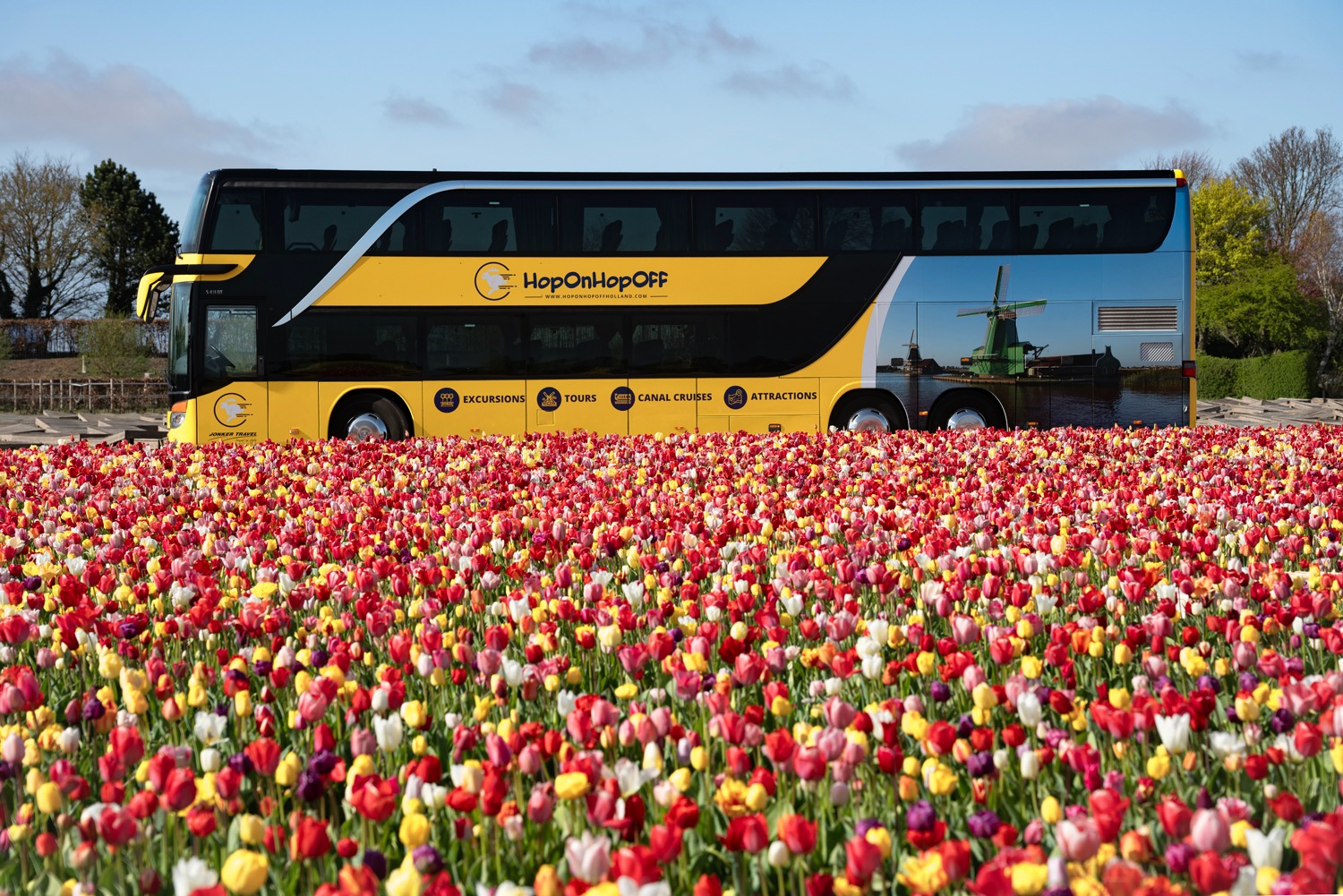
The Keukenhof tours offered through HopOnHopOff Holland depart from THIS IS HOLLAND, Overhoeksplein 51 in Amsterdam, making it possible to start the day from Amsterdam and spend several hours discovering Keukenhof.
How long should you spend at Keukenhof?
If you want to see the Oranje Nassau Pavilion, Willem-Alexander Pavilion, outdoor gardens and other major highlights without rushing, allow several hours for your visit.
Visitors interested in photography, horticulture or the individual flower varieties can easily spend most of the day in the park.
Keukenhof is not simply a place where you walk past a few tulip beds. There are gardens, exhibitions, indoor pavilions, artworks, viewpoints, restaurants and numerous places worth stopping.
Don't skip the indoor flower shows
It is easy to arrive at Keukenhof thinking only about the famous outdoor tulip gardens.
That would mean missing an important part of the experience.
The Oranje Nassau Pavilion shows another side of Keukenhof: the creativity of growers and floral designers, the enormous variety within individual flower species and the importance of the Netherlands within international horticulture.
Because its exhibitions change throughout the season, the pavilion can feel like a temporary flower museum within Keukenhof.
Our tip
Visit the Oranje Nassau Pavilion even when the weather outside is beautiful.
Many visitors mainly use the pavilions when it rains, but the indoor flower shows deserve to be attractions in their own right.
Take your time, look closely at the individual varieties and combine the Oranje Nassau Pavilion with the Willem-Alexander Pavilion and Keukenhof's outdoor gardens for a much more complete flower experience.
Why is it called the Oranje Nassau Pavilion?
Oranje-Nassau does not refer to one individual monarch. It refers to the House of Orange-Nassau, the Dutch Royal House. Members of the Royal House have carried titles such as Prince or Princess of Orange-Nassau for generations.
The name therefore represents the dynasty as a whole. It also helps explain why the colour orange has such a strong association with the Netherlands: the connection comes from the historic House of Orange.
Keukenhof has had a long connection with the Dutch Royal Family. Queen Juliana was patron of the exhibition in its first public season in 1950, and members of the Royal Family have repeatedly visited Keukenhof and performed official openings.
Food & drinks at the Oranje Nassau Pavilion
Jacoba’s Kitchen
Jacoba’s Kitchen is Keukenhof’s fully vegetarian restaurant, combining seasonal food with a convenient location inside the Oranje Nassau Pavilion.
- Fresh vegetarian meals and sandwiches
- Rendang-style pointed cabbage
- Vegan quesadilla
- Vegetarian pulled-chicken sandwich
- Coffee, snacks and drinks from the coffee corner
- Family-friendly vegetarian choices
The restaurant is scheduled to open daily from 11:00 to 18:00. Where a coffee corner is available, it generally operates from 08:00 to 18:45. Keukenhof itself is open from 08:00 to 19:00 during the 2027 season, 18 March to 9 May.
Why this pairing works: Oranje Nassau is one of the best places to combine a changing flower show with a proper meal. Visit the exhibition first, then use Jacoba’s Kitchen as your planned lunch or coffee break.
Facilities at and around the pavilion
- Seating: restaurant and terrace seating are available.
- Takeaway: food or drinks to go are available, depending on the counter and time of day.
- Families: children’s dishes or family-friendly options are available at this location.
- Free Wi-Fi: available in Keukenhof’s pavilions.
- Cashless payments: restaurants accept debit and credit cards rather than cash.
- Allergen information: ask restaurant staff if you need help with ingredients or allergens.
- Baby facilities: Keukenhof restaurants have high chairs and staff can warm baby food; changing pads are available in ladies’ and men’s toilets around the park.
- Accessibility: Keukenhof’s main routes are paved and the pavilions form part of the accessible visitor route. Busy periods may require extra time.
- Toilets: use the Keukenhof map to find the closest toilet facilities to your current pavilion.
For the easiest route between pavilions, restaurants, toilets and other attractions, use our Keukenhof map and facilities guide.
Visiting in 2027
Keukenhof is scheduled to open from 18 March to 9 May 2027, daily from 08:00 to 19:00. The entrance closes at 18:15. Flower displays, menus and individual show programmes can change during the season, so use the pavilion as part of a flexible route rather than planning every minute in advance.